Skip to content Skip to footer
{{r.fundCode}} {{r.fundName}} {{r.shareClass}} {{r.fundType}}
.wrapper { display: flex; } .wrapper img { margin-right: 20px; } @media(max-width: 570px) { .wrapper img { display: none; } } .hero-energy-lines { position: absolute; z-index: 1; bottom: 0; right: 0; height: 100%; width: 50%; background-size: 100% auto; background-repeat: no-repeat; } .hero-home .hero-header:not(:last-child){ color: #fff !important; } .hero-home p { color: #fff !important; } .container-custom { position: relative; z-index: 1; } .image { position: absolute; top: 104px; right: 0; bottom: 0; left: 54%; background-image: url('${test}'); background-size: cover; background-position: center; background-repeat: no-repeat; z-index: 0; } .section-wrapper { position: relative; overflow: hidden; padding-bottom: 7rem !important; } @media (max-width: 991px) { .image { position: static; height: 300px; } .container { position: static; } .hero-energy-lines-mobile { position: absolute; top: -486px; } .hero-home .hero-header:not(:last-child) { color: #003169 !important; } .hero-home p { color: #444 !important; margin: 0 !important; font-size: 1.125rem !important; } .hero-home { margin-top: 0; } } @media (max-width: 768px) { .hero-energy-lines-mobile { top: -311px; } .section-wrapper { padding-bottom: 0rem !important; } } @media (max-width: 441px) { .hero-energy-lines { width: 77%; } .section-wrapper { padding-bottom: 0rem !important; } } @media (min-width: 992px) { .hero-home { margin-top: 103px; } .hero-home .hero-body { top: -51.5px; } }
6 minutes to read by  J.Richardson, RBC Global Equity Team Dec 3, 2025

2025 saw a shifting economic and political landscape and some interesting moves in global stock markets. As we reach year-end, Jeremy Richardson, Senior Portfolio Manager for Global Equities, reflects on the key events that have driven equity markets.

An overview

This year has been particularly strong, with equity markets delivering approximately 20% (in U.S. dollar terms) for the third consecutive year. And interestingly, as shown below, this performance has been driven by non-US markets, with the US lagging the broader equity market.

The equity year so far
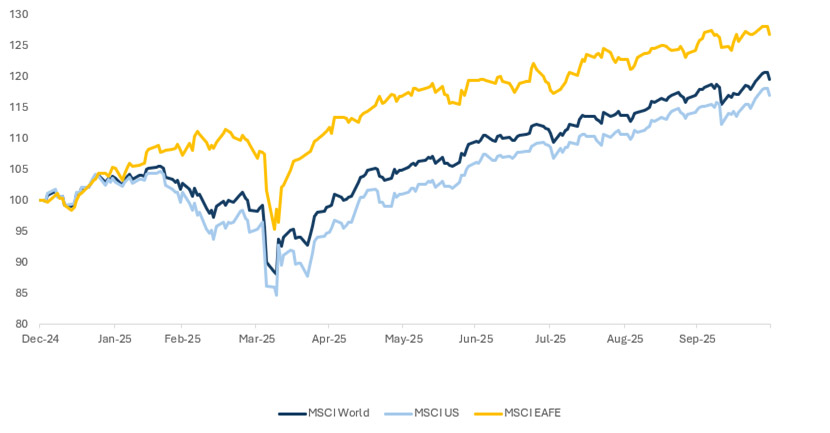
2025-from-banks-and-tanks-to-big-tech-chart-1a.jpg

Source: MSCI World Total Net Return Index, MSCI USA Total Net Return Index, MSCI EAFE Total Net Return Index, indexed to 100 at 31 December 2024; Bloomberg, as at 31 October 2025.

However, from late spring to early summer, the US started to catch up with the rest of the world. Dollar weakness has been a key theme over the year, while sustainability headwinds have impacted performance for some investors.

For example, aerospace & defence has been the standout performer this year, in contrast to food products, which have lagged behind. An identical scenario played out in the tobacco sector versus healthcare. And in terms of high versus low emissions, electric utilities have performed well while low-emitting diversified financials performed poorly.

US enterprise AI adoption inflects and CapEx responds

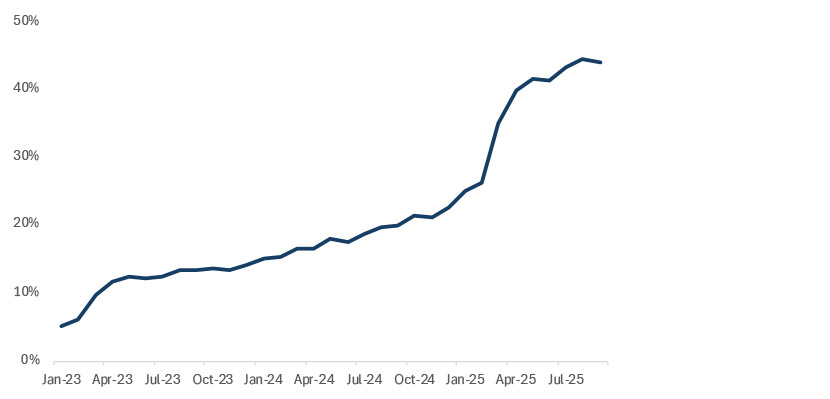
AI has been one of two major talking points this year, with a catalyst that occurred around spring. The Ramp AI Index below shows the inflection in private companies using AI, where ChatGPT went from being a chatbot to AI helping people’s working lives. This confirmed the broader AI narrative and its potentiality began to feel more tangible. CapEx forecasts are increasing, which in turn, has created a significant pick-up in activity in the industry.

Share of US businesses with paid subscriptions to AI models, platforms, and tools
2025-from-banks-and-tanks-to-big-tech-chart-2.jpg

Source: Ramp AI Index, as at 30 October 2025. Ramp AI Index measures the adoption rate of AI products and services amongst American businesses. Sample includes more than 40,000 businesses and billions of dollars in corporate spend, using data from Ramp’s corporate card and bill pay platform.

The second major topic of conversation in markets was changed spending priorities of European governments and the combination of a more expansionary fiscal approach within Europe combined with still-falling interest rates. This led to a ‘banks and tanks’ trade across the region. Aerospace & defence performed particularly strongly as a result of rearmament after decades of under-investment, while the ECB’s rate cuts had an effect on the short end of the curve. The volume of outstanding debt stock meant upticks at the long end of the curve. That was helpful for banks as their net interest margins increased.

‘Banks and Tanks’ have powered European equity markets

This ‘banks and tanks’ thematic was a very powerful driver in the market and, as a result, it impacted market returns; as at the end of October 2025, diversified banks and aerospace & defence represented nearly half the total returns in the MSCI EAFE Index. In addition, the largest 10 companies in the index comprised 29% of the total return with performance evenly spread.

In contrast, AI dominated in the US and, as a result, contributors to returns have been very different. As at the end of October 2025, semiconductors, interactive media & services and software were the strongest industry contributors in the MSCI US Index. Performance was concentrated in a handful of companies, with the largest 10 companies in the US delivering nearly 60% of the total return. The market went up by 20% in the US but it had a very different composition to other markets.

Quality struggles globally and Value diverges

US Quality didn’t perform particularly well this year but it struggled significantly in the rest of the world. ‘Banks and tanks’ are not great quality. They have been low returning industries for decades and the European banking industry, in particular, is ridden by excess capacity that never consolidated after the GFC. It is impossible to move risk across national borders as the lender of last resort is supported by national taxpayers, while the restructuring and de-regulation of the Draghi report has never really been delivered upon. Quality businesses have struggled this year and, instead, lower quality has actually performed better.

Value has done particularly well in Europe and especially poorly in the US. The US has been very much driven by Anti-Value as investors look to the future, whereas for the rest of the world, the ‘banks and tanks’ theme has been much more focused on the short-term.

The result has been regional philosophical challenges

This has created a philosophical headwind for active, long-term equity investors, such as ourselves, who focus on great business at attractive valuations.

In the US, there are many great businesses, but attractive valuations are harder to find. In contrast, outside the US, there are attractive valuations but not so many great businesses. We’ve witnessed a bifurcation in the market this year. In terms of positioning, we avoid the most expensive companies and, as always, we are selective in our approach.

Looking ahead: a K-shaped economy and K-shaped market

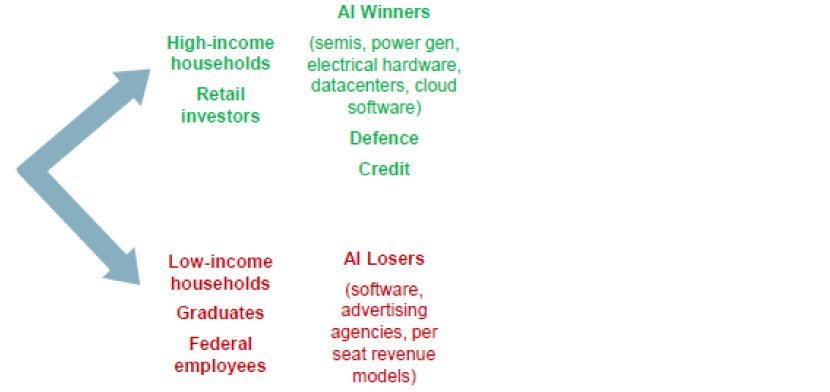
This is the concept that in the US, people with money are doing well, whereas those who don’t are struggling. Those with money are very active in the market currently, whereas those without, such as graduates and young consumers, are not participating. We’re also seeing the same K-shape in the market itself, between the so-called AI winners and AI losers. This is different to the end of 2024. A year ago, the Magnificent 7 was the key theme. Now the market is AI-driven, and we see a distinction between those who are set to succeed in this new environment and those who are unlikely to.

For investors, the current environment means portfolios should be well balanced. And that means exercising good portfolio hygiene – taking profits in some of those businesses that are doing particularly well at the top end of the K but also not turning a blind eye to certain left-behind companies with strong fundamentals, which are offering attractive relative value at present.

K-shaped economy and K-shaped market
2025-from-banks-and-tanks-to-big-tech-chart-3.jpg

Source: RBC Global Equity team, as at 31 October 2025.

All data from Bloomberg, unless otherwise stated.

Disclosure
This material is provided by RBC Global Asset Management (RBC GAM) for informational purposes only and may not be reproduced, distributed or published without the written consent of RBC GAM or its affiliated entities listed herein. This material does not constitute an offer or a solicitation to buy or to sell any security, product or service in any jurisdiction; nor is it intended to provide investment, financial, legal, accounting, tax, or other advice and such information should not be relied or acted upon for providing such advice. This material is not available for distribution to investors in jurisdictions where such distribution would be prohibited.

RBC GAM is the asset management division of Royal Bank of Canada (RBC) which includes RBC Global Asset Management Inc. (RBC GAM Inc.), RBC Global Asset Management (U.S.) Inc. (RBC GAM-US), RBC Global Asset Management (UK) Limited (RBC GAM-UK), and RBC Global Asset Management (Asia) Limited (RBC GAM-Asia), which are separate, but affiliated subsidiaries of RBC.

In Canada, this material is provided by RBC GAM Inc. (including PH&N Institutional), each of which is regulated by each provincial and territorial securities commission with which it is registered. In the United States, this material is provided by RBC GAM-US, a federally registered investment adviser. In Europe this material is provided by RBC GAM-UK, which is authorised and regulated by the UK Financial Conduct Authority. In Asia, this material is provided by RBC GAM-Asia, which is registered with the Securities and Futures Commission (SFC) in Hong Kong.

Additional information about RBC GAM may be found at www.rbcgam.com.

This material has not been reviewed by, and is not registered with any securities or other regulatory authority, and may, where appropriate and permissible, be distributed by the above-listed entities in their respective jurisdictions.

Any investment and economic outlook information contained in this material has been compiled by RBC GAM from various sources. Information obtained from third parties is believed to be reliable, but no representation or warranty, express or implied, is made by RBC GAM, its affiliates or any other person as to its accuracy, completeness or correctness. RBC GAM and its affiliates assume no responsibility for any errors or omissions in such information.

Opinions contained herein reflect the judgment and thought leadership of RBC GAM and are subject to change at any time. Such opinions are for informational purposes only and are not intended to be investment or financial advice and should not be relied or acted upon for providing such advice. RBC GAM does not undertake any obligation or responsibility to update such opinions.

RBC GAM reserves the right at any time and without notice to change, amend or cease publication of this information.

Past performance is not indicative of future results. With all investments there is a risk of loss of all or a portion of the amount invested. Where return estimates are shown, these are provided for illustrative purposes only and should not be construed as a prediction of returns; actual returns may be higher or lower than those shown and may vary substantially, especially over shorter time periods. It is not possible to invest directly in an index.

Some of the statements contained in this material may be considered forward-looking statements which provide current expectations or forecasts of future results or events. Forward-looking statements are not guarantees of future performance or events and involve risks and uncertainties. Do not place undue reliance on these statements because actual results or events may differ materially from those described in such forward-looking statements as a result of various factors. Before making any investment decisions, we encourage you to consider all relevant factors carefully.

® / TM Trademark(s) of Royal Bank of Canada. Used under licence.

© RBC Global Asset Management Inc., 2025
rbc-gam-logo
.usmf-disclosure .expandable-arrow.expandable-arrow-right { margin-right: 0.75em; order: -1; } .expandable-without-borders .card { box-shadow: none; } .expandable-container.expandable-without-borders .card .expandable-trigger { padding: 0; } .expandable-container.expandable-without-borders .card .expandable-trigger:hover { background-color: #f2f3f3; } .expandable-container.expandable-without-borders .card .expandable-content-wrapper { padding: 0; } .expandable-container.expandable-without-borders .card .expandable+.expandable { border-top: 0; } .expandable-container.expandable-without-borders .card .expandable-trigger-button-between { justify-content: start; } document.addEventListener("DOMContentLoaded", function() { let wrapper = document.querySelector('div[data-location="insight-article-additional-resources"]'); if (wrapper) { let liElements = wrapper.querySelectorAll('.link-card-item'); liElements.forEach(function(liElement) { liElement.classList.remove('col-xl-3'); liElement.classList.add('col-xl-4'); }); } }) .section-block .footnote:empty { display: none !important; } footer.section-block * { font-size: 0.75rem; line-height: 1.5; }