Key takeaways:
After three decades of deflation and stagnation, Japan has exited its “lost decade”.
Growth expectations are rising, amplified by the reflationary dynamic and corporate governance reforms.
Political stability, following the landslide election victory of the LDP under Prime Minister Takaichi, should only reinforce the positive outlook.
We expect the structural market and macroeconomic shift to create opportunities for active investors.
Despite one of the most positive outlooks for Japanese equities in decades, many international investors remain underexposed to the market.
Many investors in the market today will not have first-hand re-collection, but Japan was once the largest global equity market in market cap terms. In the late 1980s Japan accounted for around 40% of the MSCI World. What followed was three decades of deflation and stagnation. Japan’s dominant position in the MSCI World is illustrated below, with Japan the driver of Asia Pacific’s (APAC) share in the 1980s.
Japan’s C.6% weight today in MSCI World has a long history
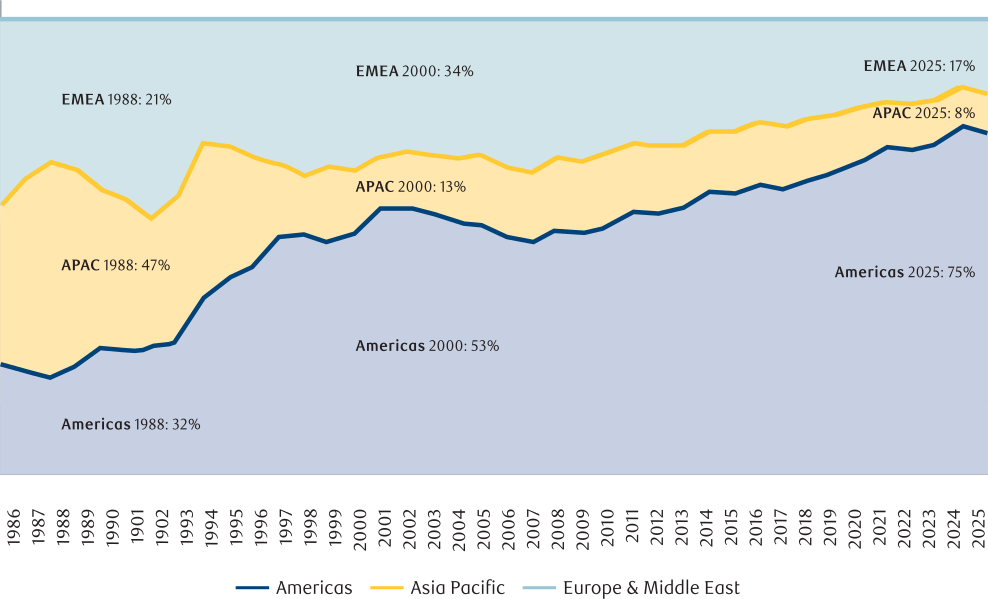
Source: MSCI, 28 February 2026
Fast forward to today, and Japan has exited its deflationary bunker and is maintaining an inflation rate around the Bank of Japan’s (BoJ) 2% target. This represents a structural shift in the economy that is helping to drive sustained earnings growth. Corporate Japan has recorded healthy earnings growth every year for the last five years, making it fundamentally different from the "lost decade" narrative that has kept global investors away.
For investors seeking greater diversification, at a time when the US has become the dominant market in many global indices, the outlook in Japan has not been this positive for a long time.
The political backdrop has potential to cement this positive dynamic
Political stability could help deliver a virtuous cycle, under the new leadership of Prime Minister Sanae Takaichi, Japan’s first female leader. After her election as LDP leader in 2025, Takaichi won a landslide general election victory in February.
This backdrop should support corporate initiatives and policy stability, providing corporate leaders greater visibility and certainty to execute strategies for value creation and shareholder returns. These include dividend payout rises, buybacks, and business consolidation, all of which are driving share price appreciation alongside earnings growth.
There are meaningful tailwinds that we expect to support performance:
Macro support: a structurally weak yen is boosting exporter competitiveness and driving tourism. The effect of the latter is to import momentum in consumption.
Thematic support: Japan's advanced R&D in semiconductors and industrial technology positions it well for global AI, data centres, and power grid investment cycles.
Flow support: additionally, over 50% of Japanese households hold a large proportion of their savings in cash due to deflationary habits - government encouragement toward equities could create significant inflows that act as a tailwind.
Why we believe an active approach is essential
Despite a historically challenging backdrop, we have found Japan to be a fertile hunting ground for stock pickers, and we believe our approach as an active manager has a strong edge when it comes to capturing alpha. We continue to feel this way even as dynamics in the region shift, with several features of the Japanese equity market calling for such an approach.
Firstly, Japan is an under-researched equity market versus global peers. More than 50% of the companies included in the Topix 500 universe have fewer than 10 analysts covering them. This stands in stark contrast when compared to the S&P500 where the equivalent figure is below 2%. Lower coverage has the potential to create significant inefficiencies in the market, which can translate into opportunities for active investors.
Almost 55% of TOPIX500 have fewer than 10 coverage analysts vs less then 2% for S&P500
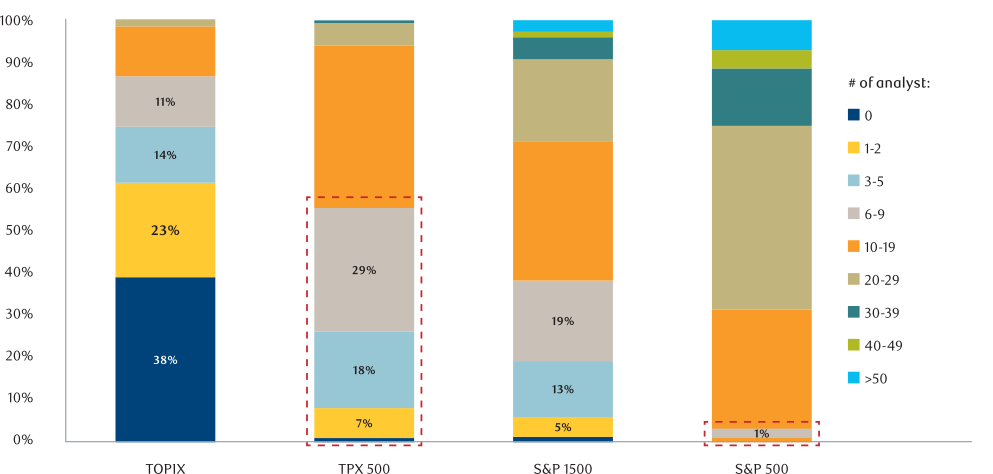
Source: CLSA Research. Data as of June 2025.
Secondly, while rising earnings and corporate governance reforms create a strong momentum narrative for the market in aggregate, there are clear winners and losers as companies adapt to rising wages and shifting global supply chains. A simple value or market cap factor focused strategy – used by many investors in the past decade – is unlikely to be rewarded in our view, with bottom-up fundamental expertise required to navigate industry disruption.
Many international investors remain underexposed to Japanese equities
Despite this positive backdrop, many investors remain underweight to Japan and are not positioned for this dynamic. This structural underweight, combined with potential household portfolio rotation toward equities, suggests additional appreciation potential as global capital rebalances into the market.
Near-term uncertainty from events in the Middle East
Japan is not immune from the ramifications of global events, including the recent war in the Middle East, given that it is a net energy importer. A macro environment of sustained higher oil prices could point to higher inflation which could complicate decision making for the BoJ, and would likely catalyse fiscal support from the government, as well as intensify a debate over renewable energy investment. However, in the face of ongoing uncertainties and rapid developments, we believe the long-term fundamental appeal for Japan equities remains intact for investors willing to look beyond near term volatility.